Visibility, visits and business results measure different things
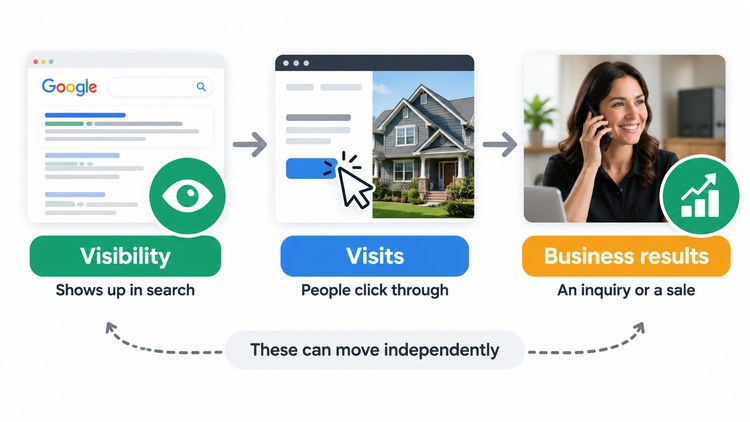
Four months may be enough time to have data worth checking, though it’s not a fixed point where you can call SEO a success or a failure. What matters now is separating three things people often lump together as “SEO results.”
- Visibility: whether a page shows up in Google Search at all.
- Visits: whether people actually click through when it does show up.
- Business results: what happens after someone reaches the site, like an inquiry or a sale.
These three things can move independently of each other. The checks below use Google Search Console to look at visibility and visits, and Google Analytics to look at what happens on the site after that.
Check whether important pages are indexed
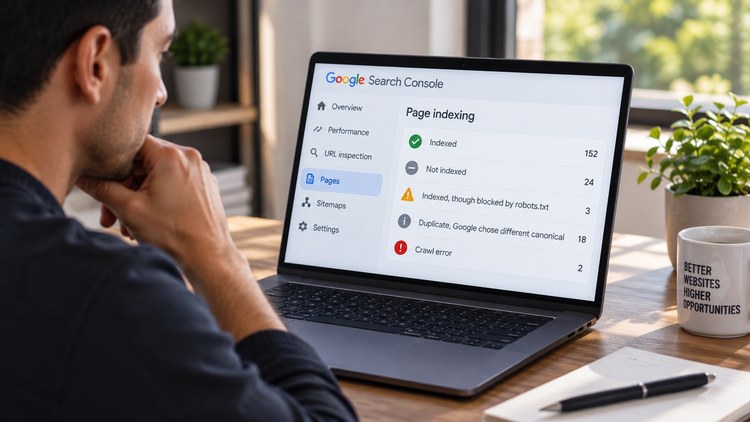
Crawling is how Google finds and reads a page. Indexing comes next: once a page is crawled, Google can add it to its index, which makes it eligible to show up in search results.
Google’s Page indexing report shows whether each known page is indexed or not.
A “not indexed” label doesn’t always mean something is broken. Duplicate pages are often skipped on purpose, pointing to a canonical page, the version Google treats as main when the same content exists at more than one URL.
Other pages are “not indexed” from a real problem, like a crawl error, so the listed reason matters more than the total count.
A page can be indexed and still carry a warning, which doesn’t necessarily mean it’s left out of results. The URL Inspection tool shows Google’s last known status for a page, not its current live state; a live test in the same tool checks the page as it exists now.
Submitting a sitemap, a file listing the pages you want Google to know about, can help Google find pages and might speed up discovery, though it doesn’t guarantee indexing or fix an existing problem.
Read Search Console performance data by query, page and country

The Search performance report tracks impressions, clicks and average position. An impression is counted each time a page’s link showed up, and a click is counted each time someone selected it.
A query is the word or phrase someone typed, and average position is roughly where the link tended to rank for it.
Breaking this data down by query, page and country shows where a change is really happening, instead of relying on one overall number. Comparing time periods, like the last three months against the three before, helps confirm whether a shift is real.
Search Console and Analytics won’t match exactly, even when both are set up correctly. Search Console counts clicks, while Analytics counts sessions, a session being the time someone spends interacting with the site, and the two systems calculate these differently.
Check for traffic drops, content quality and policy issues
The same date comparison helps confirm whether a drop is real or just normal ups and downs. A few categories are worth checking once a real shift is confirmed:
- A site-wide technical issue affecting crawling or indexing.
- A security issue, like malware or a phishing warning.
- A manual action, confirmed in the Manual Actions report.
- An algorithmic ranking update.
- Seasonality or a real shift in search demand.
Content quality is part of this same review, not separate from ranking, because quality is one of the things Google’s systems weigh. Google’s guidance on people-first content asks whether a page shows real, first-hand expertise and would satisfy someone who found it through search.
Reviewing pages against those questions can show why performance is flat even when nothing is technically broken.
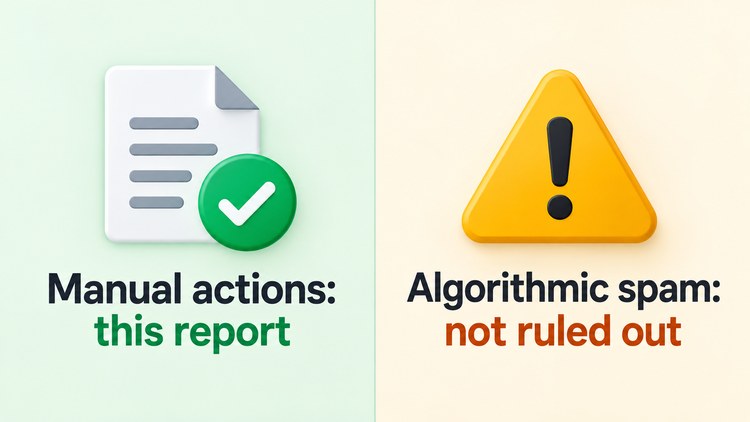
The Manual Actions report confirms whether Google has applied a manual action to the site, but it doesn’t cover every kind of spam enforcement, so a clean report doesn’t rule out every issue. Link spam, covered in Google’s spam policies, is one specific category worth checking here.
Working through indexing, performance data and content quality together is usually more thorough than checking each on its own, which is the kind of review a technical and content audit is built to cover.
Prioritize what the data actually shows

Four months of activity isn’t proof, by itself, that a campaign has failed or worked. What the checks above give you is a clearer starting point: a confirmed indexing issue, a verified drop tied to a specific time period, a content gap, or a manual action in the Manual Actions report.
From there, prioritize whatever the data actually confirmed rather than guessing at the most likely cause. Checking this data isn’t a one-time task; reviewing it periodically, such as monthly, makes it easier to catch a real change early.
How Precise Wolf reviews SEO performance that has stalled
Precise Wolf Digital works directly across SEO strategy, website design and development, and content. That hands-on view matters when an owner sees rankings or traffic move without more qualified inquiries, because the review can connect search data to the pages, site experience, and customer intent that produced it.
The review starts with the evidence already described above: indexing, query and page performance, technical conditions, content quality, and on-site behavior. The goal is not to promise a ranking deadline. It is to identify the strongest supported explanation and focus the next work on qualified visibility and conversions rather than a vanity metric.
Why business owners bring an underperforming SEO campaign to Precise Wolf
Small and local business owners often need more than another checklist when they are paying for SEO without seeing useful business results. Precise Wolf’s clients work directly with the person handling the strategy, design, development, content, and SEO, so the findings do not have to pass through an account manager or junior team before they shape the work.
That direct, month-to-month service is built around transparent pricing and qualified leads rather than guaranteed rankings. For an owner trying to decide whether the campaign needs patience, correction, or a different priority, a technical and content audit provides a documented basis for that decision.
Frequently Asked Questions About SEO Results
What’s the difference between visibility, visits and results in SEO?
Visibility is whether a page shows up in search, visits are whether people click through, and results are what happens after that visit.
How can I tell if a page is indexed or intentionally excluded?
The Page indexing report shows each page’s status and reason. Duplicates with a canonical elsewhere are often excluded on purpose, while others reflect a real issue.
Does the URL Inspection tool show what my page looks like right now?
It shows Google’s last known status, not necessarily the current state. A live test in the tool checks the page as it exists now.
Does submitting a sitemap guarantee faster indexing?
No. It can help Google find pages and may speed up discovery, but it doesn’t guarantee indexing.
Does the Manual Actions report show every type of Google penalty?
No. It confirms manual actions specifically, not every form of algorithmic spam enforcement.
How often should I review this data?
Checking in periodically, such as monthly, makes it easier to catch a genuine change early.