Findable and recommended are not the same goal

Many business owners treat “getting found by ChatGPT” and “getting recommended by ChatGPT” as one problem. They are not.
The crawler documentation cited here explains how OpenAI’s systems can reach a website. It does not explain how ChatGPT decides which businesses to mention in a specific answer.
You can check two things yourself. First, is your site technically reachable?
Second, is your content clear and accurate once someone gets there? Working on both is worthwhile.
Neither one guarantees a recommendation.
How robots.txt controls whether ChatGPT can search your site
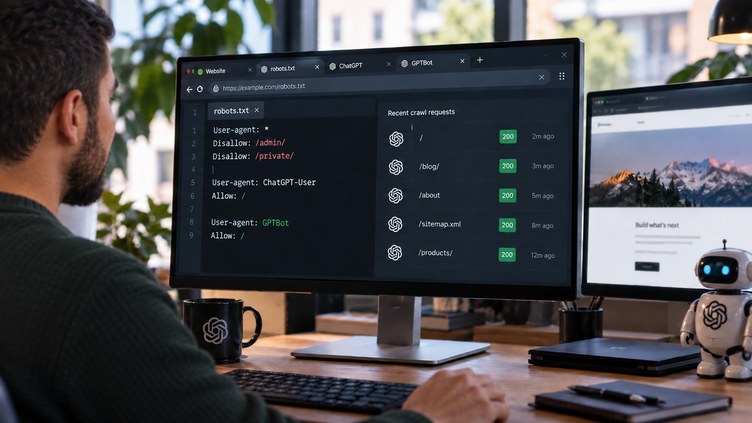
Robots.txt is a small text file at the root of a website. It tells automated visitors which parts of the site they may access.
OpenAI’s published crawler documentation describes three user agents that use this file in different ways.
| User agent | What it does | How it relates to robots.txt |
|---|---|---|
| OAI-SearchBot | Surfaces sites in ChatGPT’s search feature | Can be allowed or blocked on its own |
| GPTBot | Crawls content that may train OpenAI’s models | Can be allowed or blocked on its own |
| ChatGPT-User | Visits a page during a live user’s question | Not an automated crawler, so robots.txt rules may not fully apply |
Sites that opt out of OAI-SearchBot will not appear in ChatGPT’s search answers. They may still show up as a plain navigational link.
When robots.txt changes, OpenAI’s systems usually take about 24 hours to notice the update. That timeframe only measures recognition speed.
It does not promise that a page will be indexed or referenced in an answer.
Confirming these settings are set up correctly is part of a technical SEO audit.
Writing service pages that are actually easy to use

Once a page can be reached, the next question is whether it says anything useful. Pages that clearly state what a business does, who it serves, and how the process works are easier for any reader to use.
Google’s guidance on helpful, reliable, people-first content describes this kind of writing. That guidance was written for Google’s own search engine.
It is not a description of how ChatGPT evaluates a page.
Structured data, or schema markup, helps Google’s own systems understand page details such as pricing or services. The crawler documentation cited here does not describe a similar role for schema markup in ChatGPT.
Keeping your business information accurate and watching what happens

Basic facts about your business should stay the same everywhere they appear. This includes your services, pricing, location, and contact details.
Contradictions across your website, a directory listing, or a social profile are harder for anyone to trust. That is true whether the reader is a person or an automated system.
It also helps to check periodically what ChatGPT and similar tools currently say about your business.
Where to put your effort right now
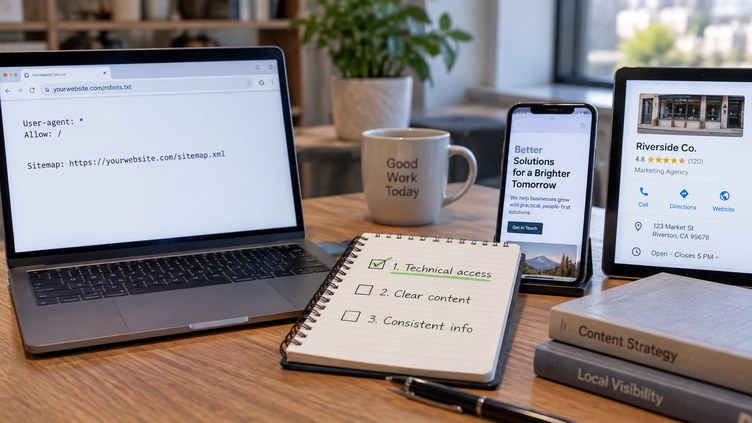
Start by confirming your robots.txt settings allow access. That is the part with the clearest documentation behind it.
From there, keep your content clear and your business facts consistent. None of this guarantees a ChatGPT recommendation.
It does keep the parts you can control in good order.
Frequently Asked Questions About ChatGPT Visibility
If robots.txt already allows access, what should I check next?
OpenAI publishes specific IP ranges for its crawlers alongside its robots.txt guidance. Confirm that your server or firewall is not blocking those published ranges.
A server-level block could stop access even when robots.txt allows it.
Should a business allow GPTBot if the main goal is showing up in ChatGPT search?
OAI-SearchBot controls eligibility for search inclusion, though it does not guarantee that any given page will appear. Disallowing GPTBot only indicates that content should not be used in future training.
A business focused on search visibility can allow OAI-SearchBot while disallowing GPTBot, since the two settings work independently.
If schema markup does not guarantee a ChatGPT recommendation, is it still worth adding?
Schema markup helps Google’s own systems understand details like pricing or services on a page. The crawler documentation cited here does not establish a similar effect for ChatGPT.
It is worth adding for its documented Google benefit rather than as a ChatGPT tactic.
How should a business keep track of how AI tools describe it over time?
Check periodically what ChatGPT and similar tools say about your business. A single result is a snapshot, not a fixed pattern.
Treating this as an ongoing check makes more sense than a one-time test.
Does showing real, first-hand expertise on a service page matter beyond crawlability?
Google’s helpful content guidance identifies first-hand knowledge and direct experience as a marker of useful writing for readers. This does not establish that it determines ChatGPT’s selection process.
It remains a reasonable content practice on its own terms.
Will GPT and other AI respect your robots.txt?
I’ve heard from other website owners that they don’t. That even if you disallow that your content will still be used.